
I don’t recall when we first heard about comet Neowise. It suddenly appeared on the news and within days the internet was flooded with guides on how to get a good photograph. If I hadn’t already dabbled in a bit of astrophotography this year, then I probably wouldn’t have bothered, but I saw it as a challenge. One I simply couldn’t resist.
The planning took on nightmare proportions though. First of all, I had to check the weather forecasts for a clear night. Then I had to study the dark skies map to find suitable locations free of light pollution. I spent hours in Stellarium working out the azimuth to fit in with foreground interest, also checking the height of the comet to ensure it could be covered with my lens set at 24mm. The Photo Pills app became another useful tool. My husband and I drove to several likely spots to check the suitability. Some were too far, like Margate, a two-hour drive from home. I had an idea to photograph the Anthony Gormley statue staring out to sea with the comet above. Of course, this also involved checking the tide tables. I wanted the statue to be roughly knee-deep in water and thankfully everything came together on a clear night.
Setting out as my husband was going to bed, I arrived in Margate just after midnight. Parking up next to the Turner Contemporary gallery, I could see two problems before I even got out of the car. The first was that the tide tables were clearly wrong and waves were crashing up the lifeboat ramp. (I was to discover much later that the tables contained a small note at the top saying to add one hour for the months between March and October). The statue appeared to be completely covered in water. If that had been my only problem, then I would have waited, but nothing could have prepared me for the horrendous light pollution. There appeared to be at least three huge ships just off the coast and they were lit up like Christmas trees. Behind was a long string of red lights, perhaps warnings on wind turbines and yet according to Google those are more than seven miles offshore. (On commissioning it was the world’s largest offshore wind farm). During the long drive home, I kept thinking about other locations I might try before the comet started to fade from view. I actually missed a turning off the motorway and ended up getting lost, finally getting to bed at nearly 3.00 in the morning.
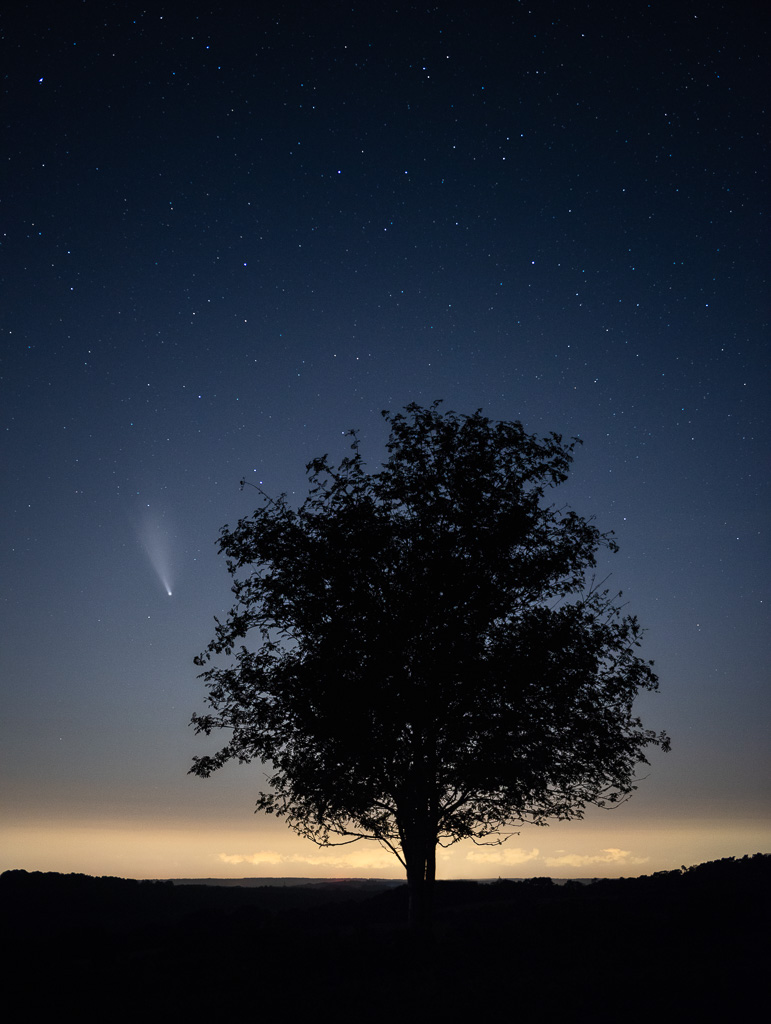
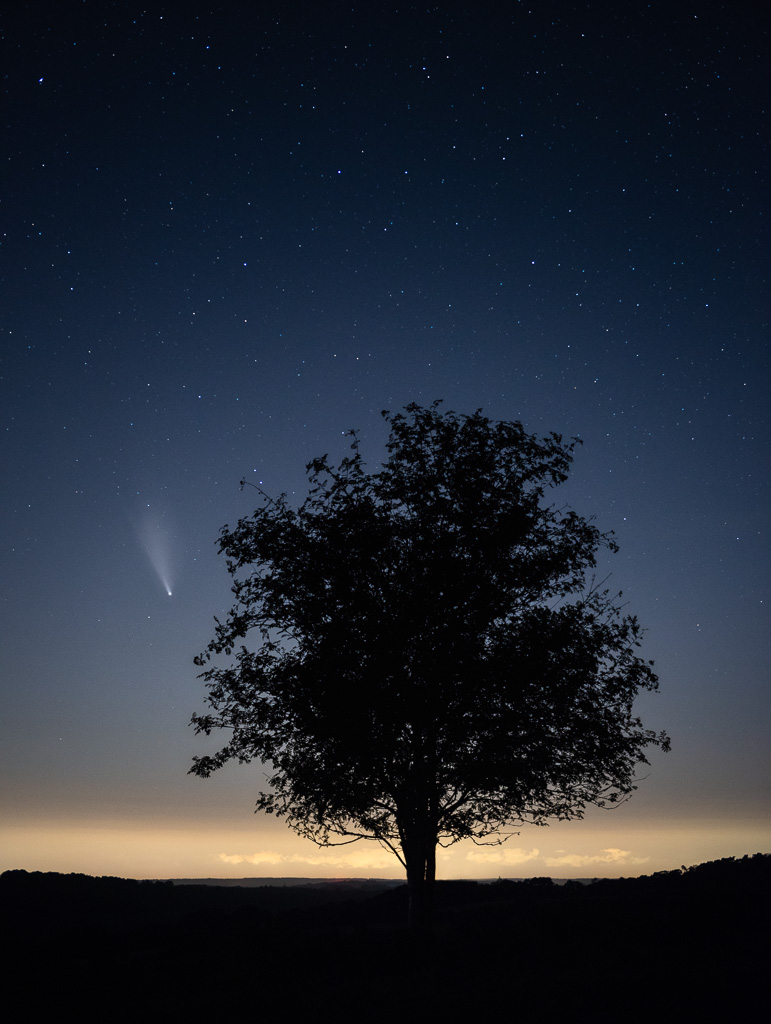
The photographs shown here were also quite problematic to shoot. The one at the top was at least fairly local, involving a drive of around 25 minutes. However, the comet was fading by then and could barely be seen with the naked eye. That meant setting up the composition was a matter of trial and error. By the time I had everything ready and had finally managed to focus stack on both the tree and then the stars, the comet had moved too far to the right. At one point I fell down a ditch in the pitch dark while carrying the camera fitted to the tripod. Miraculously I kept those held aloft, but I hurt my ankle badly in the process.
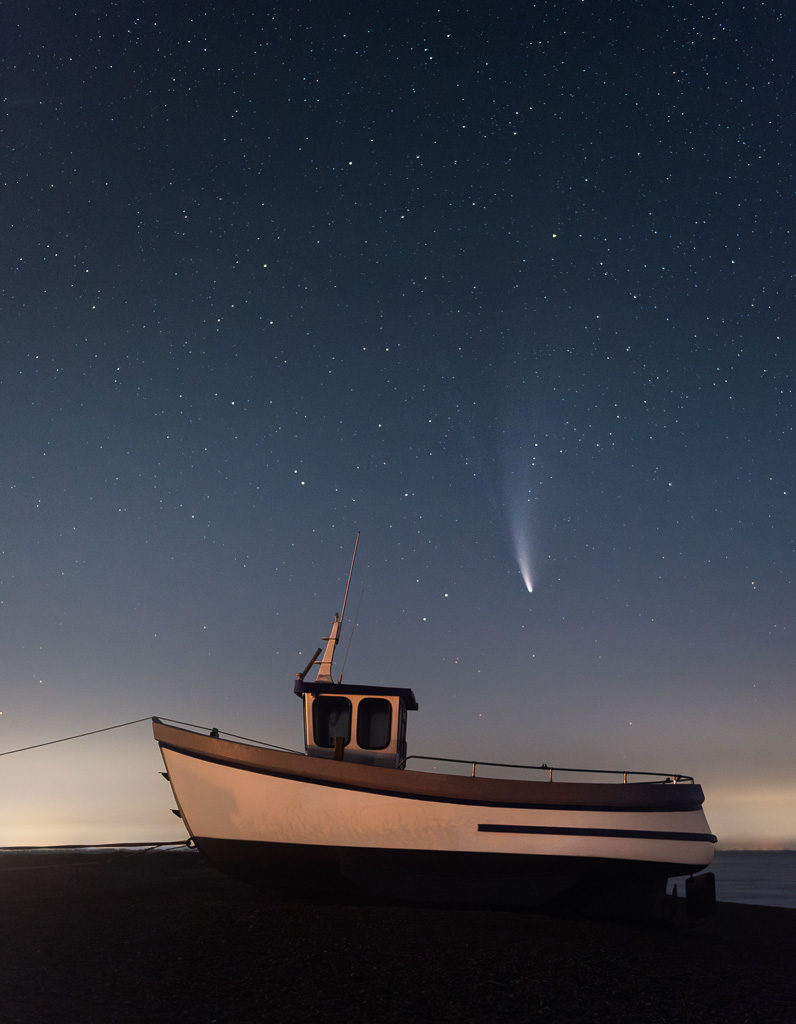
The image below also suffered from terrible light pollution. My husband travelled with me to Dungeness on that occasion and we spent a frustrating two hours up and down the beach trying to fit the comet with a boat that didn’t reveal all the lights from a nearby village.
In spite of the difficulties, I’m so glad we made the effort. Neowise won’t be passing this way again for another 6,800 years.


Steve Cullum
29 Sep 2020Well worth the effort and two really good shots.
Zooey
30 Sep 2020Thank you Steve 🙂
Sid
1 Oct 2020A new adventure to take awesome, fascinating shots!
Here, it was impossible to watch the comet, it has been cloudy all the time… all the time…
Have a wonderful weekend 🙂
Sid
Zooey
2 Oct 2020I’m sorry you didn’t see the comet. Many of my photographer friends up north didn’t see it either. You have a wonderful weekend too! 🙂