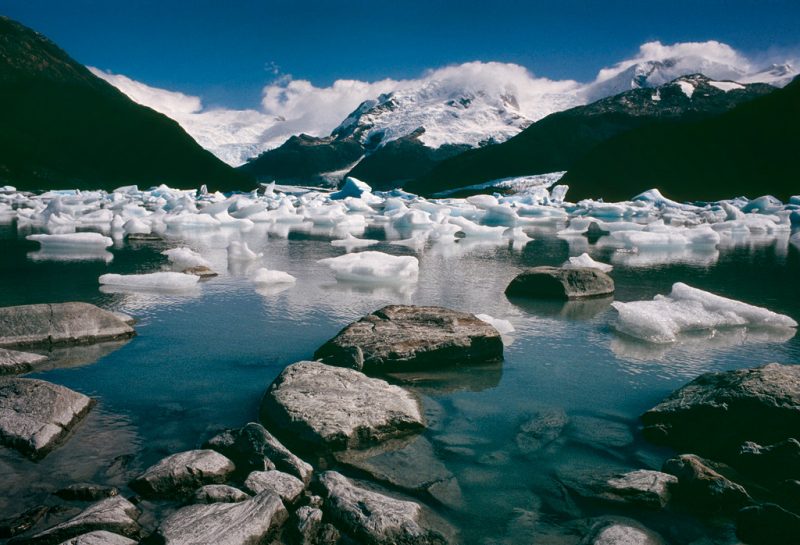
I’ve been trawling through some of my oldest images looking for inspiration and my eyes landed on a handful of scanned slides from my first trip to South America. It lasted for nearly four weeks and involved travelling along the Pan American Highway from Lima to Arequipa, followed by a flight to the northerly Chilean city of Arica. We spent one full day on a minibus, driving out to Lake Chungara and the volcanoes Parinacota and Pomerape. (These can be seen in the image below).

It was a long and tiring day, but one of the best I can recall and as we watched the sunset over the Atacama desert, I admitted to my travelling companion that I would be happy if the bus were to miss one of the deadly bends. Oddly enough, she told me she had been thinking exactly the same thing.
The next day we were on the train to La Paz, a journey of 273 miles and reaching an altitude of nearly 14,000 feet. While researching the details, I was saddened to find the passenger service on the “Ferrocarril de Arica-La Paz” was actually closed in 1996 due to a lack of demand. That is a great pity as I believed it to be one of the greatest railway journeys in the world. The little train had a cook on board and I distinctly recall lace tablecloths being laid on tables between the seats, together with a small vase of fresh flowers, while our lunch was prepared at the end of the single carriage. We stopped part-way across the altiplano to see the incredible sight of a huge lump of ice in the blazing sun. I can find no reference to this now, but if my Spanish was up to the job, I think this was due to a fractured water pipe and the resulting spray freezing overnight.
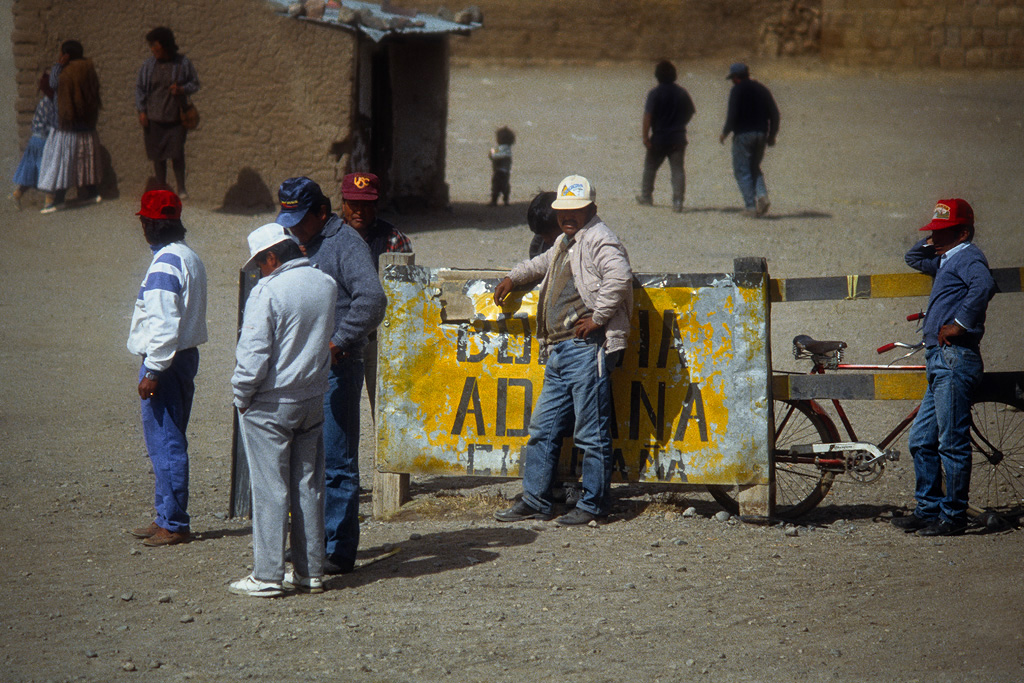
Waiting at the Bolivian border.
Nothing compares to arriving at the top of the canyon surrounding La Paz and then sitting on the train as it zig-zags its way down to the city below. The view is similar to the photograph featured at the top, which was taken from a park the following night.
We drove all the way up to the very highest point above the Bolivian capital. At around 18,500 feet, you had to do everything in slow motion.

We finally left La Paz and drove for around three hours to the shores of Lake Titicaca. We were fortunate to spot two locals out on the lake in one of their traditional reed boats.